Programmers are still the dominant users of UI and, thus, drive AI use cases. The much larger market are “normies,” people outside of the IT department who are doing “knowledge work” and other tasks in organizations. I asked the AI to pull together a list of what those activities are and the momentum around them. Here it is. As ever, I did not spend a lot of time verifying that the extraction was correct.
Below generated by AI on July 8th, 2026.
Battery Ventures – State of Enterprise Tech Spending, June 2026
Survey of 100 CXOs representing ~$66B in annual tech spend. PDF
- 50% of enterprises are already scaling agentic workflows across business functions (p. 3)
- Knowledge management & documentation is the #1 IT initiative being re-evaluated due to AI, at 76%; ITSM modernization at 69% (p. 10)
- 53% of ROI-positive enterprises name software development as the #1 ROI area – non-dev use cases remain largely unproven on ROI (p. 12)
- Human-agent modes: 48% human-in-the-loop, 31% human-on-the-loop, 14% humans orchestrating agent systems, 6% fully autonomous (p. 15)
- Business functions (marketing, sales) influence the AI agenda in 59% of enterprises but own it in only 4%; HR is not involved in two-thirds (p. 16)
- Top agentic focus areas after software dev (79%): customer support (63%), IT ops (60%), cybersecurity (57%); then a cliff to supply chain (15%) and financial ops (14%) (p. 22)
- Already-operational autonomy concentrates in marketing/content (17%), software dev (15%), customer support (14%); financial ops and supply chain lag at 21% and 25% expecting agent-owned workflows within two years (p. 23)
- Goldman Sachs Research forecasts 12% of knowledge workers using agentic AI by 2030, 37% by 2040 (footnote, p. 22)
Anthropic – How People Are Using Claude Cowork, July 2026
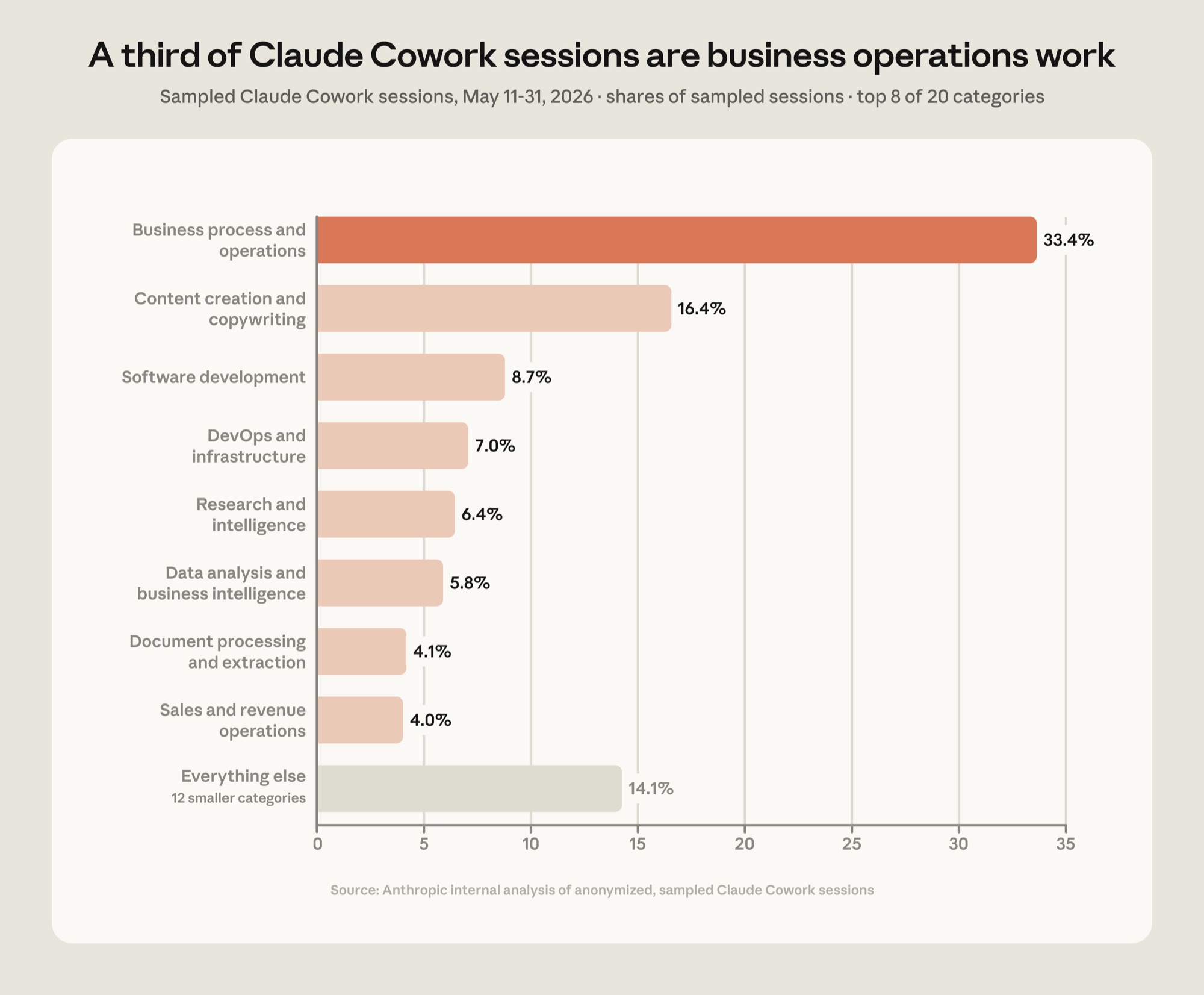
1.2M anonymized sessions, May 11-31 2026, 600K+ organizations. Blog
- Business process & operations is the largest usage category at 33.4%: pulling scattered updates into reports, onboarding checklists, spreadsheet reconciliation
- Content creation & copywriting is second at 16.4%: drafts, decks, posts, proposals
- Software development is only 8.7%; DevOps 7%; research & intelligence 6.4%; data analysis 5.8%; document processing 4.1%; sales ops 4%
- The top two categories – roughly half of all usage – are connective work that surrounds every role, not the core of any single role
- Developers use Claude Code for core coding work and Cowork for the same connective, communications-focused tasks as everyone else
- Cowork exists because non-technical users kept adopting Claude Code despite the terminal being intimidating
Anthropic – Economic Index

- 93% of Claude conversations produce a recognizable artifact; top outputs are explanations (17%), documents/reports (15%), guidance (11%). Written deliverables are roughly a third of conversations; code roughly a sixth. (June 2026 “Cadences” report)
- Usage is diversifying: the top 10 tasks fell from 24% to 19% of Claude.ai traffic between November 2025 and February 2026 as coding migrated to Claude Code and the API; ~49% of occupations see Claude used for at least a quarter of their tasks (March 2026 report)
- Office & Administrative tasks are 15% of API traffic vs. 8% of Claude.ai – routine admin work is already a programmatic, automated workload (January 2026 primitives report)
OpenAI & NBER – How People Use ChatGPT, September 2025
1.5M conversations, 700M weekly users, ~10% of global adults. Blog / paper
- Writing is the top work task: ~40% of work-related messages. Two-thirds of writing requests are editing or modifying provided text, not generating from scratch
- Coding is ~4% of consumer messages; Technical Help declined from 12% to ~5% of usage in a year as programming migrated to APIs and coding agents
- ~49% of messages are “Asking” (advice and decision support), 40% “Doing,” 11% “Expressing” – people value ChatGPT as an advisor as much as a task machine
- Three-quarters of all conversations fall into practical guidance, seeking information, and writing
- Go-to-market roles (marketing, comms, sales, CX) are major adopters; most departments stick to low-friction core features while advanced features concentrate in technical roles (work adoption report)
Gallup – Workforce Surveys
- 50% of US workers use AI at work at least a few times a year as of Q1 2026 – more than doubled in three years; 13% use it daily, 28% at least weekly (Q1 2026 survey, 23,717 US employees)
- 65% of employees at AI-adopting organizations say AI improved their productivity; managers report benefits more than individual contributors (~7 in 10 vs. just over half)
- Tool mix among AI users: chatbots 61%, writing/editing tools 36%, coding assistants 14%. Top uses: consolidating information (42%), generating ideas (41%), learning new things (36%) (Q3 2025 wave via The Hill)
- About half of US employees use AI once a year or never; 46% of non-users with access prefer working the way they do now (AP/Techxplore)
BCG – The “Silicon Ceiling”
- 75%+ of leaders and managers use gen AI several times weekly; frontline worker usage has stalled at ~51% (via Founder Reports roundup)
Shadow AI / BYOAI
- 66% of office professionals have used AI at work despite believing it violated company policy (PagerDuty 2026 Shadow AI Survey; 1,250 professionals in explicitly non-IT roles at $500M+ revenue companies)
- Shadow AI detections rose 4x year-over-year and are now the third most common non-malicious insider action; 45% of employees are regular AI users on corporate devices (Verizon 2026 DBIR, via TechTimes)
- 78% of AI users bring their own AI tools to work (Microsoft & LinkedIn Work Trend Index, 2024)
- Breaches at high-shadow-AI organizations cost ~$670K more, a 16% premium (IBM Cost of a Data Breach Report, 2025)
- Unauthorized AI usage drops significantly when approved alternatives are provided (2026 healthcare sector survey, via Unseen Security roundup)
- 49% of workers admit adopting AI tools without employer approval; 86% use AI weekly at work; 69% of C-suite are fine with unsanctioned use, prioritizing speed over privacy (BlackFog survey of 2,000 workers at 500+ employee companies, via CIO.com)
Platform Engineering 2.0 – Personas (Broadcom / Weave Intelligence, 2026)
- Developer-only focus is one of five structural ceilings of current platforms: security teams, data engineers, ML practitioners, FinOps analysts, and business users have been second-class citizens or excluded entirely (p. 11)
- Six first-class personas the platform must serve: app developers (including an emerging agentic-AI-developer sub-class), platform engineers, security/compliance teams, engineering & business leaders, data scientists/ML engineers, and AI agents – the first net-new persona in over a decade (pp. 21-22)
- Business leaders need live cost-attribution dashboards, DORA telemetry, and AI-readiness indicators, not monthly PDF reports (p. 21)
- Persona scope is the most underrated PE 1.0 limitation: leaving security, data science, FinOps, and agents to build their own toolchains produced shadow IT at scale (Ron Westfall, HyperFRAME, p. 21)
- Platforms designed exclusively for the app-developer persona leave ~60% of potential enterprise value on the table (Roy Illsley, Omdia, p. 22)
- Shadow AI sprawl is a new AI attack surface the platform must absorb, alongside prompt injection, model poisoning, and inference data leaks (p. 28)
- Persona-specific experience layers (portals, CLIs, APIs) should sit over a shared platform API surface; fragmented backends create fragmented governance (p. 22)
- Context: 90% of organizations have adopted platform engineering; 76% have a dedicated platform team (State of Platform Engineering / DORA 2025, cited p. 5)

Leave a Reply