AI is valuable to individuals – it automates not only much of their busy work but also their valuable work and, when I look at the anecdata (including my own use), it improves the quality of what they do.
Of the 54% who used AI in the past year, “about three-quarters say AI is increasing productivity and enhancing the quality of their work.” Among the ones using GenAI every day, “nine in 10… say they’ve not only experienced such improvements, but they also expect to see further advantages.” “Global Workforce Hopes and Fears Survey 2025,” PwC, November 12th, 2025. n=~50,000 workers, 28 sectors, 48 economies.
Getting to that point – humble brag? – takes a lot of effort. So your goal in using AI shouldn’t be to improve productivity (do less for the same amount of work, or more work), but to be better at the work you’re currently doing…and maybe one day do more of it.1
Anyhow.
There’s lots of surveys that show this: workers report success with AI; organizations are finding AI ROI elusive. Here’s an aggregate of several of those surveys in a chart. And, yes, made by my robot, who I will now hand this post over to:
The Altitude Problem
Ask an individual whether AI made them more productive and about four in five say yes. Ask an organization whether AI moved EBIT and it is fewer than two in five. Ask whether AI moved EBIT by at least five percent and it is one in sixteen.
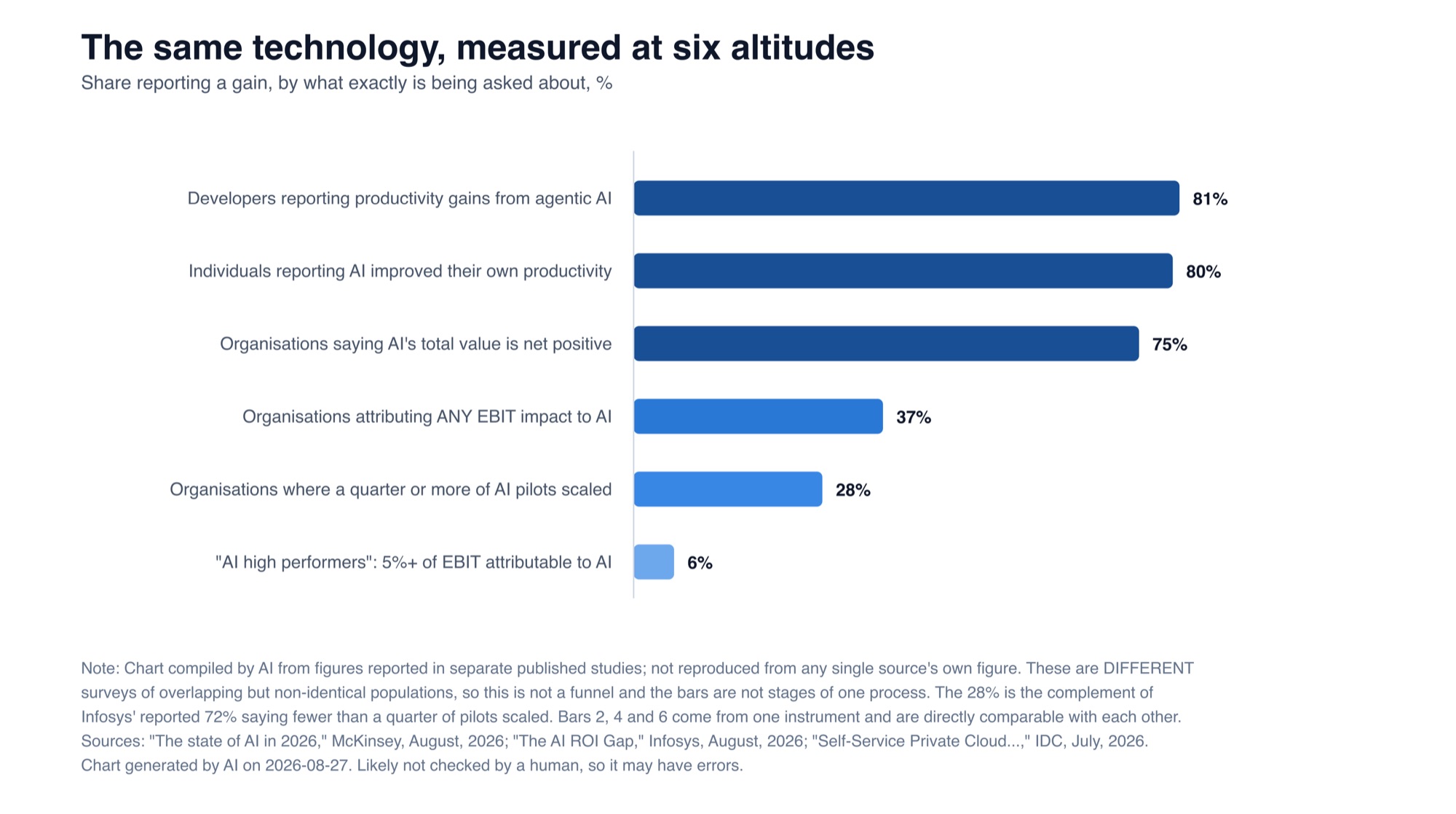
This is not a funnel: three organizations surveyed three overlapping but non-identical populations, and nobody measured the same firms at every level. What it shows instead is that the reported benefit of AI is extremely sensitive to the altitude at which the question is asked, and a spread running from 81% to 6% is far too large to be sampling noise. One figure is derived rather than printed – the 28% is the complement of Infosys’ reported 72% saying fewer than a quarter of their AI pilots ever scaled.
Sources
- “The state of AI in 2026: On the road to ROI,” Dan Tinkoff, Lieven Van der Veken, Michael Chui and Tara Balakrishnan, McKinsey & Company, August, 2026. Online survey in the field 4 May to 8 June 2026. 1,719 participants in 97 nations, across the full range of regions, industries, company sizes, functional specialties and tenures; 36% at organizations above $1 billion in annual revenue. Data weighted by each respondent’s nation’s contribution to global GDP. Bars 2, 4 and 6.
- “The AI ROI Gap: Turning Ambition Into Enterprise Value,” Infosys, August, 2026. Fielded January 2026, so the numbers are seven months older than the publication date. 1,010 senior executives at US companies above $500 million in revenue, with AI-specific questions asked of the 1,006 whose organizations use AI. Divisional president 29%, EVP/SVP 21%, CTO/CIO 14%, COO 12%, CFO 11%, CEO 7%, CISO 6%. Ten industries at 10% each: banking and capital markets, healthcare and life sciences, manufacturing, retail, consumer packaged goods, insurance, energy, utilities, telecom, high tech. Bars 3 and 5.
- “Self-Service Private Cloud as the Engine for In-House AI and Application Innovation,” Matthew Flug and Adam Reeves, IDC, July, 2026. White paper #US54784226, sponsored by Broadcom. Draws on IDC surveys conducted between December 2025 and April 2026; sample size and respondent profile are not published in the paper. Bar 1.
1. If you want, you could also just work less, whatever “work” means to you. Like taxes. It will totally rip through taxes in a completely verifiable way. But, we’re not supposed to ever suggest working less. What would be the point of that? ↩
Comments
One response to “AI is valuable to the individual, less so to the organization”
Mentions