Technology’s primary effect is to amplify human forces. Like a lever, technology amplifies people’s capacities in the direction of their intentions. Geek Heresy, Kentaro Toyama.
AI amplifies what you have: it will make good processes gooder and faster, it will make bad processes badder and faster. This means three things if you want to achieve enterprise ROI:
1. You must change how your organization works and thinks to take advantage of AI
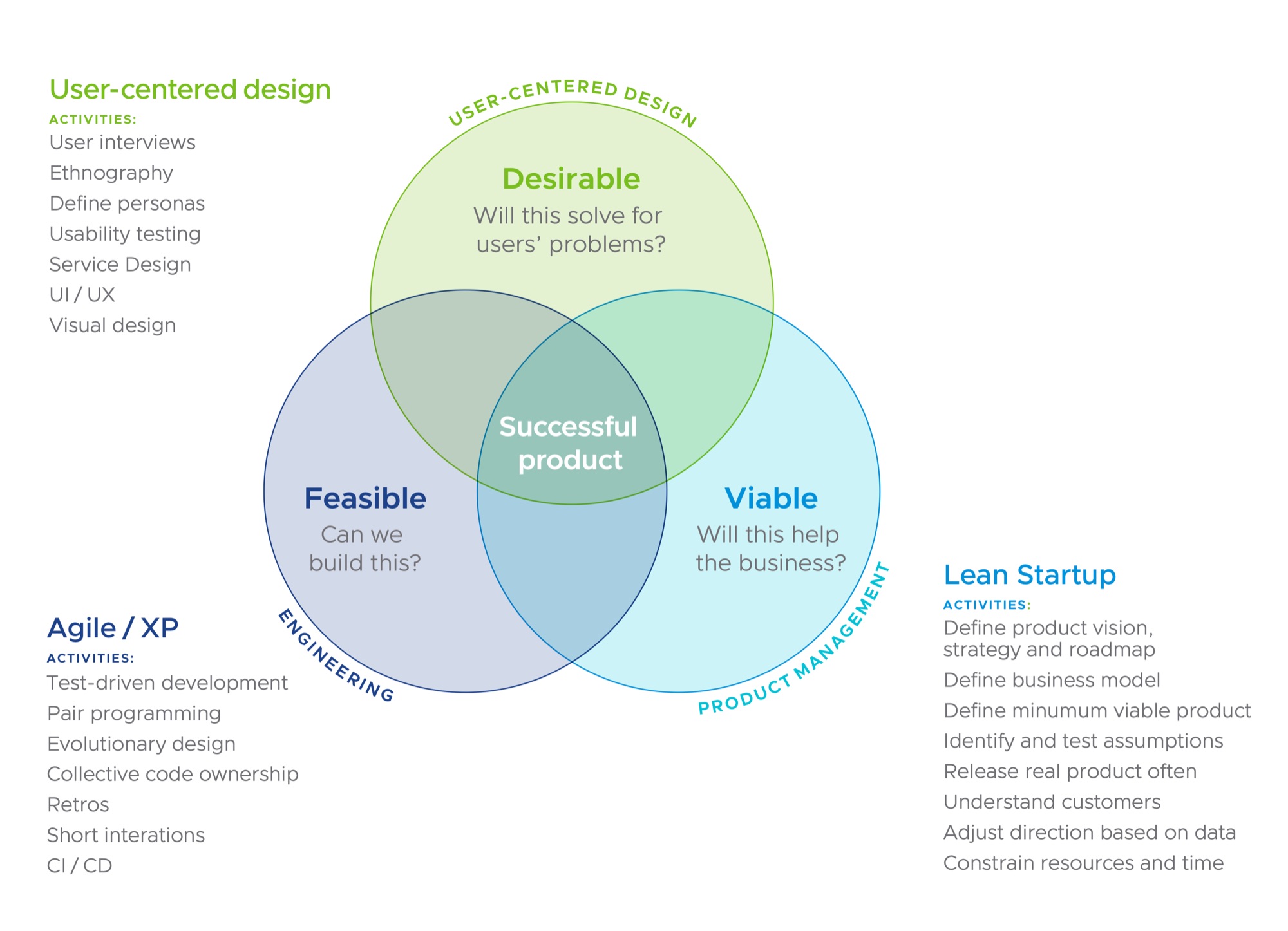
For example, when the Tanzu product management team started using AI, they soon found they needed to dramatically change how they worked. Instead of specifying exactly what a feature was and how it should work, they moved to an intention-based way of working.
The humans would tell the AI the intention of a new feature – a fancy way of saying the “desired outcome.” Then they would let the AI iterate on various ideas, often prototyping it out, until the team saw something that matched. This loop was so quick, in fact, that they could even start to ask customers if the feature and implementation matched their needs.
“Culture” change also means changing the organization structure. Instead of using the traditional split between product management, design, and development, the R&D org went to a balanced team approach (“pods”) where those roles worked more closely.
You have to do some organizational changes. So, we reconfigured some of our development teams into a pod-like model, where we had the software developers paired with the product managers, the UX, the architects, the end-to-end testers all together in a small pod, and gave them more responsibility with AI, but also gave them more accountability so that they could discuss things faster, resolve things faster, and move much faster. Purnima Padmanabhan, Tanzu GM.
Collapsing previously separate teams into one eliminates a major bottleneck in software development: the hand-off time and loss of understanding that happens when each group passes their unit of work over to the next team. eXtreme programming, agile development, DevOps, and now AI-driven software development have all discovered this workflow and design principle: Conway, blah, blah, blah.
But, you have to change your organization and how they work (the “culture”). If you don’t, AI will just make how you’re currently operating more like how it already is.
A test for applying AI: are you changing team and organization structure to remove communication, hand-off, and responsibility friction? If not, enterprise AI ROI will continue to be elusive.
2. Eliminating bullshit work to focus on better products and operations
Eventually, all enterprise work includes a bunch of paperwork, bureaucracy, “bullshit work.” This work has a negative effect on your business because it is navel-gazing rather than focusing on building a better product, optimizing how you operate, and otherwise working on making more money.
You can get an academic diagnosis of this in Seeing Like a State: the need to measure and manage a resource becomes the work instead of the product. You can get an airport business book version in Bullshit Jobs. Using AI to eliminate that bullshit work is a major benefit. Again, this is something the Tanzu product management team saw:
We used to do this through Jira, right? It was Jira – fill out scenarios, create epics and then stories and all these things. And we don’t really do that anymore. We talk to our agent. Our agent then goes and creates the tracking through Jira to send it through… versus being so bound to process and focusing on, “Okay, I’ve got to create this Jira, and I’ve got to create all these acceptance criteria.” It’s more of a conversation, like you and I are having, through a chatbot, that ultimately ends up with the assets we need to pass it through the system.
Here is what a product manager should focus on instead of PM-paperwork, adapted from David Pereira’s commentary on using AI for product management1:
- Creating value for customers and the business.
- Showing results instead of outputs.
- Talk business potential instead of shiny solutions.
- Align people instead of pleasing everyone.
- Outlearn your competitors. The faster you learn, the quicker you succeed.
Numbers two to five are about how a product manager operates inside a company, the activities they do but also the mindset they have, rely on, and try to instill in the rest of the organization.
Those goals are also about personal ROI, ensuring that you are seen as valuable and stay employed, grow comp, and gain power. As ever, even for the product manager, your employer is customer number one.
That is all “culture.”
The first (“business value”) is anodyne and like saying that a good business focuses on making money.
Here are more specific examples from the McDonald’s IT team after talking with their customers, the owners/operators/managers of/at stores2.
First, “the customer” wants to speed up the ordering process and, I would guess, remove the need for human employees to be involved as much as possible, i.e., “friction”:
One of the biggest moments was seeing operators react to how the ordering experience adapted in real time to different customer needs and interactions, including the language differences they navigate in their restaurants. For many, it clicked instantly. This wasn’t just about efficiency – it was about reaching more customers without adding complexity to their teams.
It made one thing clear: our goal is not just to build smart tools, but to build inclusive ones that adapt to different environments and remove barriers in fast-paced settings.
Second, “the customer” wants to apply analytics to immediately improve how the store is running:
One moment that stood out was a conversation with a franchisee who, while looking at a demo, walked through a real scenario from their restaurant and asked how they would make a staffing decision during a peak rush if multiple things were happening at once.
That question quickly became very real. In that moment, shift leaders are balancing staffing gaps, crew positioning, breaks, and unexpected changes, all while trying to keep the restaurant running smoothly.
In discussions like that, the strongest value signal was that restaurant teams do not need more dashboards, but instead want real-time recommendations that help shift leaders decide what to do next during the rush.
What’s happening here is that product managers, designers, and even developers are finding ways to make the business run better, either through making a new or better product, making it so customers can give you money faster (removing friction) and like your product, increasing internal-facing productivity/removing costs, finding money on the table, and otherwise “solving customer problems.”
I go over this at length to make a point about PM-paperwork. None of it really addresses any of those goals. It’s about documenting and tracking the work done, measuring it.

AI can automate a lot of the paperwork, so much of it, so easily, that you start to wonder why you were doing it in the first place. It is tempting to have AI generate all of that paperwork, and then further optimize to have another AI consume it. If there is no human in the loop…what was the point?3
To take advantage of AI, this means a product manager needs to change how they think of and work with all of this paperwork.
To generalize it to all enterprise AI work, I would put in this test: when you use AI, do you end up doing less paperwork and more focusing on “customer value”? If not, you haven’t changed your “culture” enough, and enterprise AI ROI will continue to be elusive. You are only making “better” the bad processes you’re using.
Improving with frequent feedback from small batches
When it comes to “culture eats tech innovation ROI for breakfast,” back in the digital transformation days, I liked to short-hand the culture change with the phrase small batch. Companies would put Tanzu Platform (then, Pivotal Cloud Foundry) in place and could shorten their software release cycle from a year to a week.
Obviously, they weren’t releasing every feature in an annual release cycle in one week. Instead, they could take one or two feature ideas and get it all the way from idea on Monday to production on Friday.
With more frequent releases, you can try more new things, get more feedback about what works and doesn’t work, and eventually get to better products, or whatever else in the “customer value” list above. This works best when you involve the customers and observe how people actually work and use your software. The same “just ask the frontline workers” applies to AI projects too.
This is the same case as with AI speeding up things. You need to change how you work to adapt. Unsurprisingly, the move was the same thing: collapse teams down, and change how you operate to take advantage of weekly feedback. As the Tanzu PM, Chris, told me:
We want to be able to sit down with one of our customers and they have a feature request or an idea or some feedback, and we’re feeding it into the intent director. It’s going through and it’s spitting out a prototype even within a couple hours that we can get back on the call with the customer and go, “Hey, is this what you were looking at?” And they go, “That’s exactly what I want.”
[…]
[Right now,] on average, we’re anywhere from 36 to 48 hours, but our intent is to get to that 24-hour cycle.
Taking advantage of AI is the same formula as 2015: shorter release cycles, balanced teams, and a platform that can deploy securely as fast as AI can code.
3. Getting humans out of the loop, eliminating cow-paths
Much like with bullshit work, it’s clear that AI can simply automate more business processes, the day-to-day things a business does. As much as we all hate it, customer service is one. There seem to be some analytics tasks that it can fully automate. There are places where you can just remove a human from the loop entirely. Or, at the very least, figure out when to escalate to a human. This relies on trusting the AI a lot, but I’d theorize that there are numerous internal-facing tasks in an organization that are low-risk and easy to recover from.
It is time to stop paving the cow paths. Instead of
embedding outdated processes in silicon and software, we should obliterate them and start over. We should “reengineer” our businesses: use the power of
modern information technology to radically redesign
our business processes in order to achieve dramatic
improvements in their performance. “Reengineering Work: Don’t Automate, Obliterate”, Michael Hammer, Harvard Business Review, July-August 1990.
Next, as the 1990 piece above says: can you just stop doing something entirely? As the above two items go over, a lot of your processes are done because humans are involved and need inputs/outputs. In those cases, if there are no humans, perhaps you don’t need to do the thing. This way of thinking can go too far and result in explosive diarrhea. But, I suspect you can figure out controlling the blast radius better than people named Big Balls.
You can learn and adjust your expectations:
Mistakenly we thought that by just introducing artificial intelligence and ingesting the design requirements that we had, that that would produce a high-quality product. Charles Poon, Ford.
Being a person, I’m biased against the answer being “fire people.” At best, as with Ford, it seems like you get short-term balance sheet wins, some comp reduction laundering, but then you’re like, “oh fuck.”
I would use a different test here: if you are not eliminating some business processes, enterprise AI ROI will continue to be elusive.
The parts to change

Let’s reduce this down to something catchy that could fit on a McKinsey slide. AI amplifies what you already are, which means the work is changing what you are before you inject a bunch of AI and fire a bunch of people.
My theory is that there are three moves.
- Structure: collapse the teams and hand-offs so the org stops bottlenecking itself.
- Focus: cut the paperwork and navel-gazing, and then make sure people spend their time on customer value instead of documenting it.
- Scope: stop doing the things you only did because a human was in the loop.
Do that, and AI makes a good company gooder and faster. Or, you could just keep your culture the same, and you’ve bought an expensive way to do your bad processes badder and faster.
I bet you need a platform to help you do all this, right? You should TryTanzu.ai!
- See a more detailed look in the VMware Tanzu/Pivotal Labs Product Manager Playbook. ↩︎
- I suppose you would say “restaurants,” but describing a fast food place as a “store” feels more correct. ↩︎
- In regulated enterprises, one of the major points of paperwork is to create a paper-trail to (1) show that processes were followed, and, thus, that your organization is operating legally, but also to (2) prepare the path to blame-storming when things go wrong. ↩︎
Leave a Reply