Original: Beyond the Pipeline: A Gender Lens on Priorities and Exit Triggers in the High-Tech Industry by researchers at The Academic College of Tel Aviv-Yaffo, Communications of the ACM. Summarized by Claude AI on July 2, 2026.
The Findings
- Men are far more committed to staying. 44.9% of men selected “no intentions to leave” vs. 25.8% of women. In regression models, gender was the only significant variable – not age, parental status, role, or company type.
-
Women’s exit triggers are environmental, not substantive. Work-life balance and working hours are women’s top two triggers; they rank fourth and fifth for men. Women also cite workplace atmosphere significantly more. None of the big gender gaps involve the actual work.
-
Women talk about work more negatively than men – 0.445 vs. 0.492 average sentiment (p = 0.0002). Notable because in general conversation the pattern runs the other way: women usually score more positive. Work specifically flips it.
-
Compensation is priority #1 for everyone, but more so for men (74.9% vs. 56.2% top-three selection). Women’s priorities spread more evenly, with WLB chosen at over twice the male rate (55.1% vs. 26.2%) and remote work higher too. Men lean on team dynamics.
-
Company values rank dead last – 57.2% marked it their clear lowest priority, more so for men. For men, compensation and values are top and bottom; women weight them roughly equally.
-
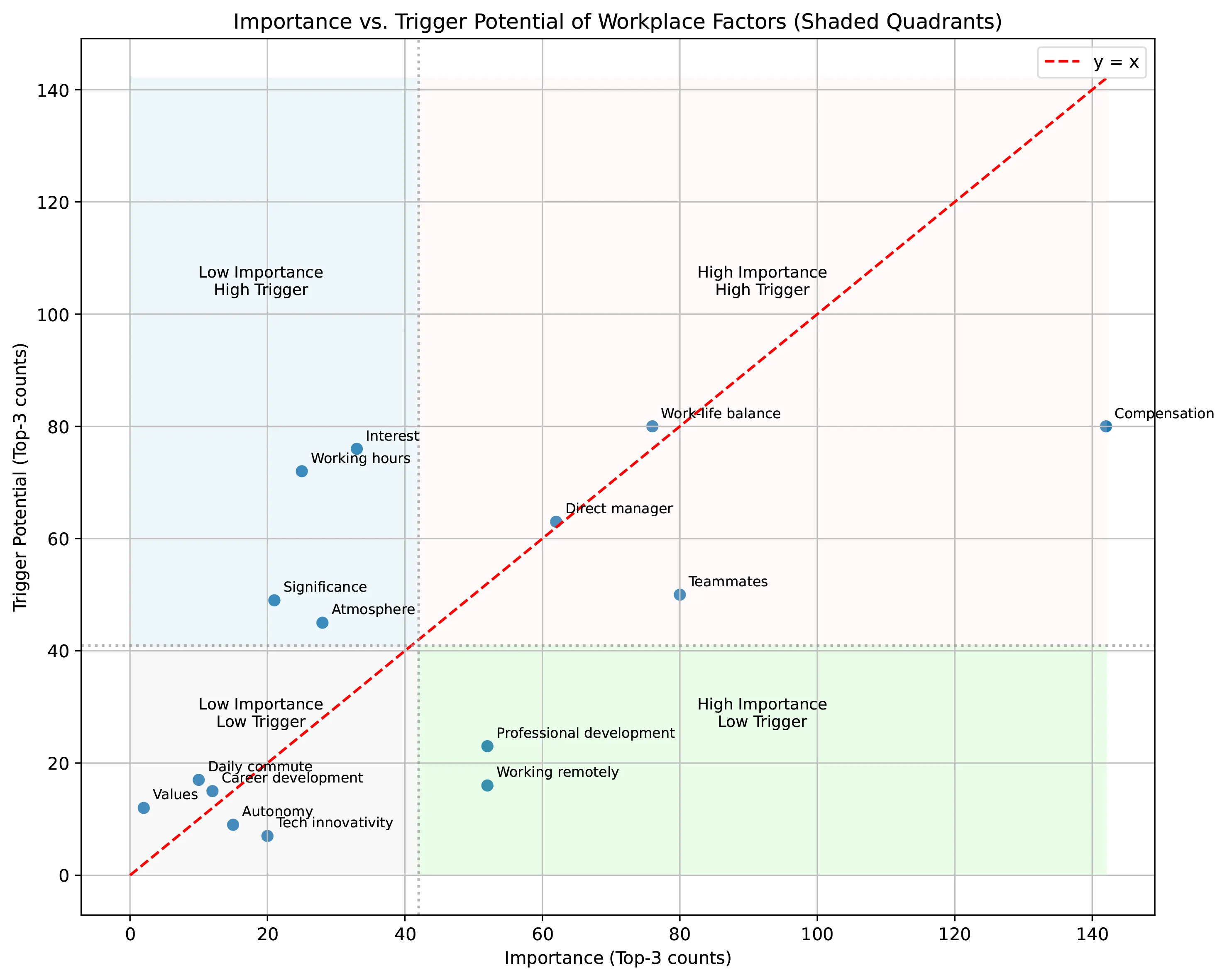
Priorities and exit triggers don’t align. Professional development and remote work are valued but rarely quit-worthy. Working hours, interest, significance, and atmosphere are the inverse: low stated importance, high trigger potential when they go bad.
-
Work environment was never rated a low priority by anyone – the only category with a floor under it.
What This Says About Tech Workers Generally: A CIO’s Guide
The study’s most useful contribution for a CIO isn’t the gender split – it’s finding #6, the misalignment between what people say they value and what actually makes them leave. Your engagement surveys are measuring the wrong thing. Employees will tell you they care about compensation, professional development, and remote work, and they do – but two of those three are “valued but tolerated” factors. People appreciate them without quitting over them. Meanwhile the factors that actually eject people – hours, atmosphere, whether the work feels interesting and significant – don’t show up prominently in stated priorities. They’re background conditions, invisible until violated. Think of it like oxygen: nobody lists it as a top-three priority, but remove it and watch what happens.
The practical translation: retention is loss-prevention, not perk-provision. Adding professional development budget or remote flexibility earns goodwill but doesn’t lock anyone in. Letting hours creep, letting a toxic team fester, letting someone stagnate in boring work – those are the actual departure mechanisms, and they’re precisely the things that don’t surface in a priorities survey. A CIO who wants leading indicators should be instrumenting for deterioration in the deal-breaker quadrant: sustained overtime patterns, team-level attrition clusters, engineers stuck on maintenance work for quarters at a time.
Second lesson: compensation buys entry, not loyalty. It’s the top stated priority and a real trigger, but it scores higher in importance than in trigger potential. People rarely leave purely over pay if the deal-breakers are intact – and competitive pay won’t hold someone whose deal-breakers are violated. Pay is table stakes; the environment is the game.
Third: don’t spend retention budget on values messaging. Company values ranked as the clear lowest priority for a majority of respondents. Mission statements and culture decks don’t retain engineers. The lived environment – teammates, manager, atmosphere – was never rated low by anyone. That’s where “culture” actually resides for these workers: in the daily texture, not the poster in the lobby.
And the gender finding, restated for general use: if a definable segment of your workforce is quietly more exit-prone than the rest, the causes are probably structural (hours, flexibility, atmosphere) rather than compensatory, and they won’t show up until people are already gone. The women in this study weren’t leaving over less interesting work or worse pay – they were leaving over conditions the organization could actually change. Which is either damning or hopeful, depending on whether anyone’s listening.
Links
🤖 Beyond the Pipeline: A Gender Lens on Priorities and Exit Triggers in the High-Tech Industry – Survey of Israeli CS alumni finds women in tech far more likely to consider leaving than men, driven by work-life balance, hours, and workplace atmosphere rather than pay or the work itself. Stated priorities and actual exit triggers diverge, so retention efforts based on what employees say they value miss the real deal breakers.
Original: Beyond the Pipeline: A Gender Lens on Priorities and Exit Triggers in the High-Tech Industry by researchers at The Academic College of Tel Aviv-Yaffo, Communications of the ACM. Summarized by Claude AI on July 2, 2026.
Leave a Reply