
Everyone is excited about AI improving how organizations’s work. Reducing costs, bringing in more revenue. You know “productivity.”
How is it going three years after the release of ChatGPT? Here are some recent headlines and excepts:
- 56% of companies getting nothing out of AI, PwC research says; chairman blames forgetting the basics.
- (On the same PwC study) Majority of CEOs report zero payoff from AI splurge.
- More than half of CEOs report seeing no benefits from AI deployment so far – only 12% of business leaders hit the jackpot of higher revenues and reduced costs.
- “While two-thirds of AI decision-makers say their organization uses genAI in production, only 15% report a positive impact on earnings, and just a third can link AI spend to profit and loss. Confidence in ROI is dropping, as well: In late 2024, 81% of firms reported 5% or greater ROI; by mid-2025, that fell to 62%!”
- Deloitte sees enterprises adopting AI without revenue lift
- McKinsey wonders how to sell AI apps with no measurable benefits.
There’s that 95% of AI projects fail survey from the summer of 2025, but I think that’s been largely “well, actually“‘ied and I wouldn’t recommend thinking about it.1 That’s driven from a Wharton study that’s much more positive: “The study found that 74% of businesses that measure the ROI from their generative AI efforts are already seeing a positive return, and more expect to see a positive ROI within the next two or three years.”
For the sake of our 401(k)’s let’s hope that study is right.
AI Won’t Fix Your Broken Culture
When it comes to elusive AI ROI, the biggest, bestest “how to get there” take is the old saw that you need to change the company’s culture (meaning, process and organization structure, mostly) to get the rewards of AI. AI won’t fix your broken culture, to use an old framing.
The real barrier to unlocking AI’s value is no longer technology; it’s bringing people along the journey. AI doesn’t create impact or value in isolation. Muqsit Ashraf, Accenture
Keith Townsend has been giving good advice and doing good takesmanship here:2

I tell you what, when culture is the problem, you’re kind of fucked. Remember every single big, enterprise technology innovation?
Maybe the “you” here is IT. IT can’t change culture, budget, and all that RACI. That’s The Business’s job. The CIO needs to find a “partner” in the business who’s read The Octopus Organization and said “been saying this for years, and here’s my 12 month plan to do the shit out if. ‘Send me your deck’? It’s a six page memo, mofos.”
Do employees think the executives have a culture change plan? In most surveys, not really. As one said: “only 18% of employees surveyed felt leadership had a clear vision for navigating change as agentic AI tools begin automating manual processes.”
Here’s one, possible, story of doing it right:
Unlike vague projections, DBS uses a rigorous benchmarking approach to quantify AI-driven value. Customer outcomes from AI-powered solutions are compared against control groups, ensuring that the S$1 billion figure reflects tangible, measurable benefits rather than theoretical estimates.
In plain accounting terms, that value can be traced to three general areas that combine to produce banking profit: increased revenue, cost savings, and risk avoidance. Since the revenue is generated through various lines of business – grouped under consumer and institutional banking – the bank keeps developing and deploying AI use cases custom-built for each line of business to boost their interest income, fees, and commissions (the three main sources of income). Likewise, in terms of costs and risk-weighted losses, a deliberate focus on specific AI use cases that offload costs and avoid risks helps to produce tangible economic value.
Moreover, DBS Bank tracks economic benefits accrued by customers, manifested through their financial well-being as a result of growing their savings, reducing debt, and increasing investments. In terms of soft metrics, the bank looks at customer and employee satisfaction and engagement attributable to their use of AI-powered tools and services.
As with most summary coverage of improvements, that’s a bit light on details, but it shows you the shape of things.3
I hear you. All of these people have a stake in being hired to fix this problem, especially the big consulting firms (PWC, Accenture, McKinsey, Forrester, etc.) that put out most of these surveys. But, that doesn’t mean they’re wrong.
Executives Don’t Know What’s Happening
It could also be that The Business just doesn’t know what’s actually going on. They can’t measure how AI is improving things, so they can’t manage it. Here’s a chart from the Wall Street Journal:4
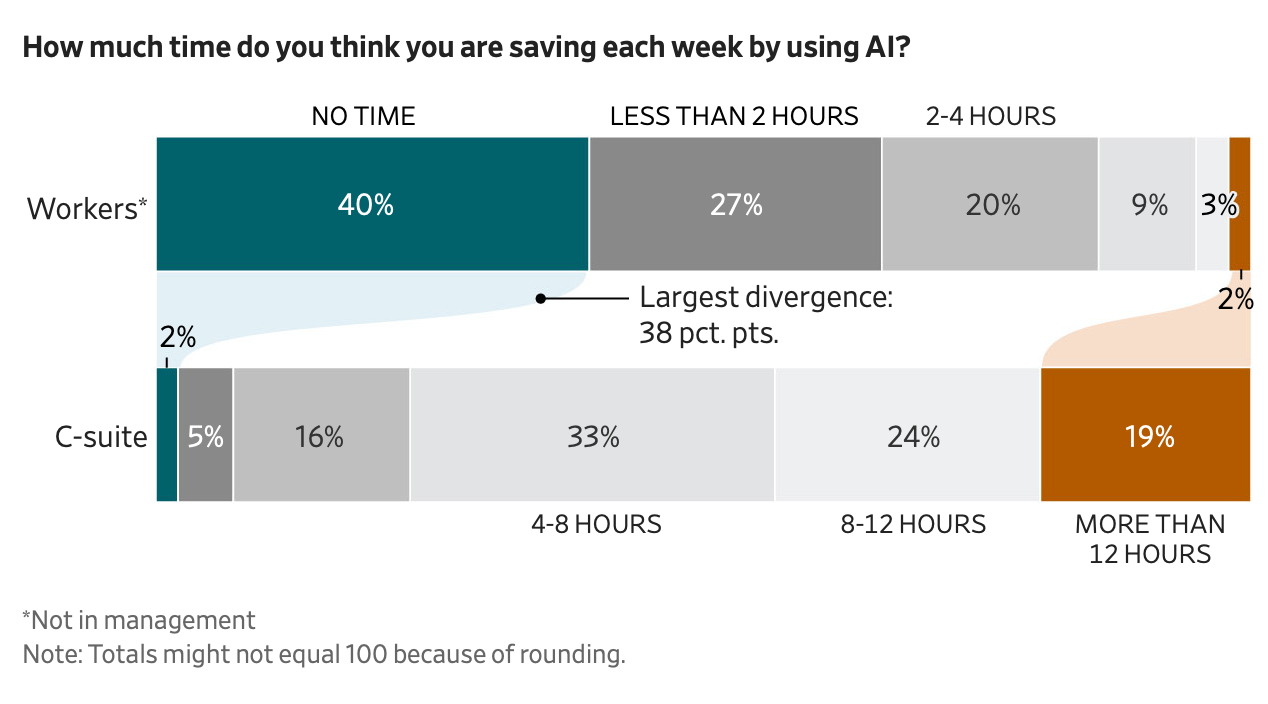
The chart above is interesting. Executives say they’re getting value. And I bet they are. Talking with an AI about is a lot more efficient than an endless series of meetings. It’s also more efficient than all the bullshit work teams of people have to do for the slides in those meetings.
What IT can/should do right now
What IT can do is shift from a project mentality to a platform mentality. That’s table stakes. You always need a platform. Otherwise, you end up with sprawl. Each of those little AI projects has it’s own way of running, it’s own ways of managing, and its own way of applying security patches. It’s Shadow AI. Get a platform.
The second thing IT can do is use AI in programming. That is proven to be a good idea. Everyone’s doing it. Is it perfect? Not at all. As with most technology driven change, we’re judging AI-driven coding by higher standards than we judge human-driven coding. It doesn’t need to be perfect, it only needs to be faster at the same human-based work, or 10% to 20% “better.” I think we’re there with AI coding.
The danger for executives here is thinking you should fire all the developers. This means you can make more changes to existing applications and make more applications. If you’re a half-way decent company, this means you can make more money while spending the same amount of money. Growth!
Day Two AI Operations
The other important angle here is that the AI-generated code is not perfect. It still needs programmers to guide it and, likely, debug and evolve it. Even more, you have to look beyond programmers into “day 2.” Once the developer is done, that’s when most of the expensive, dangerous work happens: running the software and updating it. That is: operations. For AI-generated apps, no one is talking about that.
Imagine that currently your organization’s developers and operations staff support 10,000 application. You know, you’re a big-ass bank. You add AI-generated apps, and now you support 20,000 applications. Or let’s say you 4x to 40,000.
Everything will break if you 4x, even 2x your infrastructure’s usage over a few quarters, even four.
What’s happened is that you’ve unlocked the app deliver bottleneck and are now finding not only the next bottleneck in IT, but finding the limits of your IT portfolio. All your infrastructure and the management of it just can’t support a 2x or 4x, y/y increase in usage.
I talked about handling this with one of Home Depot’s former platform engineering managers:
Remember when I said we all have something to sell. Here it comes!
The AI Platform is a solvable problem
If you’re working at a larger organization here’s some good news. You probably have a good platform in place already. Tanzu Platform is proven to address these two problems and speed up human developers. Many large organizations have Tanzu Platform in place. We’ve seen proof in several organizations in the past year that the platform works well with putting AI in the loop. For example, our own IT department (Broadcom GTO) is using the Tanzu Platform in the development process to use AI in secure and well governed environments.
For decades, “build vs. buy” was the defining question for enterprise applications. That 2x to 4x flood of AI apps means that buying is the clear winner. It’s tempting to try building this platform yourself. The industry has spent many years trying that, and the result is a mess.
IT can’t change The Culture. What IT can do it quickly put a platform in place to handle the huge load increase successful enterprise AI will bring. If you build the platform, you’ve got a 12 month delay, you better nail it the first time, and then you’ve got to keep funding and evolving it. That’s silly-think when you could just buy it and move onto more valuable uses of headcount and priorities.
Stop building platforms, and start building apps. TryTanzu.ai.
-
He’s got a consultative service you can do with him to sort your shit out. Meta-note: he’s doing great weaving together advertising for this service and providing good advice/content. I like the stuff he’s been doing for the past ~6 months a lot. ↩
-
Here’s a positive case from BBVA, but also just focused on outcomes, not HOWTOs. Also, of course, using generative AI for better search and analytics/ML is doing well. ↩
-
If I connected the dots right based on chart colors, this other article is from the same survey and has these demographics/authorship: “Source: Section survey of 5,000 white-collar workers from companies with 1,000 or more people in the U.S., U.K. and Canada conducted Sept. 26-Nov. 3, 2025; margin of error: +/- 1.4 pct. pts. STEPHANIE STAMM/WSJ” ↩
Leave a Reply