👔 How AI could help and harm management consultant firms

Here is a question from Andrew Citera in the Software Defined Talk slack:
Do you think this tech will eventually replace consultants or do you think it just adjusts the human capital leverage factor? E.g. an industry company hires an “AI-driven consultancy” and that consultancy has an onboarding process to train / tune its models and then can deliver a project with XYZ less # of consultants in a shorter time period vs. an industry company just interfacing directly with an “AI Consultant” tool and the people consultant part is just a vestige of a bygone era?
-
For consulting, my best case scenario is that it increases the profit margin for consultants and their revenue if they decide to try harder rather than work less. With an well trained AI and methodologies for using it, could can get past the first week’s worth of work (interviewing the clients, analyzing the stack of stuff they send over, SWOT analysis (or whatever people use for market and competitive advantage theorizing analysis) and then putting together a deck of findings and possible next steps. You know, all the “summer intern” stuff we joke about.
-
This would save travel expenses, the need to pay for staff that do that, the time spent collecting, ingesting, and “synthesizing” it all, etc.
-
If the AI spit stuff back out for clearity and concising, and also offered 3–5 different perspectives, you could also get more value out of “smarter” (and more experienced) consultants and partners who normally couldn’t spend their time to understand what the summer interns (so to speak!) were writing. Your “smarter” people would have to spend less time loading up that analysis to think of advice.
-
Instead of just “first week” this could even be the first month depending on slow the client acts and can schedule meetings.
-
This efficiency means you can either work less or do more. I think we know that big firms will choose number two (why relax?!) and get more engagements rather than focusing on work/life balance.
-
This also means consultancies can go down-market and sell cheaper engagements. In fact, consultancies could load up their corpus, previous engagements (as sanitized for confidentiality) and standard methods (the McKinsey method, BCG, etc.) into self-service sessions. Sure, the results might be generic and not customized, but a growing toy store (or BBQ chain) that has three locations and is looking to expand into two other cities wouldn’t ever be able to afford a full on McKinsey engagement so would take what they could get.
-
If I imagined myself doing a boutique shop (like the consultative stuff at RedMonk), I would widen the client base by using AI to do two things: the initial interview of my customers and related people, which would include asking, let’s say 3 levels deep of 5 why’s; putting together five to ten possible things for me to suggest/think about to them.
-
This would cut down a lot of bullshit work at the start.
-
The human element here would be that each step I’d spot bozo and unhelpful stuff in the process.
-
The worse case scenario is (stick with me for some philosophy stuff) is that the AI exposes that most consulting is just recycling old ideas and stating the obvious (a consultant just looks at your watch and tells you what time it is). If the customers realized this, they would just the AI and their own analysis of it.
-
To get around this, you’d have to train the AI on your own brain and corpus, keeping how you think a (literal) trade secret and copyrighted so that no other model could legally use your “thinking.”
-
For example, if you trained an AI on Gartner you’d get a significantly different set of advice about, say, developer relations, than if you trained it on RedMonk. Both should use all legal means to prevent free-for-use AIs (let alone competitors!) from including their material in the AI’s training base.
-
Of course, you could just use sovereign cloud to move your training and AI out of jurisdictions that pursued copyright claims and stuff.
-
And, then, from the other side, the buyer side, you could start this loop all over again. If you had a good Salesforce/ERP programmer/database analyst, you could load up all your historic and “real-ish time” data into the consultants suggestions and ask it to spit out 5, 10, 35 scenarios – etc.
-
Partners could also use the AI to make their relationship with clients better. First, they could have the AI analyze and figure out when they should have a client “touch” – you know, talk with them to remind the client that the consultancy firm exists, try to drive more business, etc. Second, partners could use the AI (again, trained on proprietary models) to come up things to say to the client. This could be answering questions of proactively raising topics. Again, this would save time and resources: the partner doesn’t need to stare at a whiteboard and come up something, and when the partner farms out the answer to the “summer interns,” the interns could take less time or just not need to do any work at all. This means the partners relationship management could scale meaning you’d either need less partners or could take on more work. Again, because large firms are probably interested in more money over working less, I’m guessing they’d choose the second.
-
Also, when it comes to annual bonuses, you might could level the playing field. Instead of partners (and everyone else) having to write their own scripts for justifying why they get more money than other people, the entire firm could have the AI go write an analysis of each employee based on everything the firm had done, customer results, etc. I don’t actually know how bonus allocation works in firms, so I don’t really know what I’m taking about here. You could also comp. this against other firms, but that seems like a bad idea for everyone involved.
If I was in consulting, this would be one of the most exciting times since all those engineers thought to apply structured thinking and models to business development. And, sue, I’m a classic “innovator” on the diffusion of innovation curve so I’m eager to try practically anything that’s new. But, I don’t know, there doesn’t seem to have been much operational innovation in consulting for…uh…since the growth-share matrix?

🤖 AI Log Book
I’ve moved my AI experiments over to a blog rather than clog this newsletter up. Here’s some recent ones: a realstic looking hot dog walking through a desert happy but thirsty, what they carry on them as an adventurer, knolling, illustration, detailed vivid colors and watercolor background; values (this one didn’t go well); “A bottle of wine shared with a loved one is worth far more than filing expenses.”
💸 Looks like you might be getting 3% to 10% raise this year
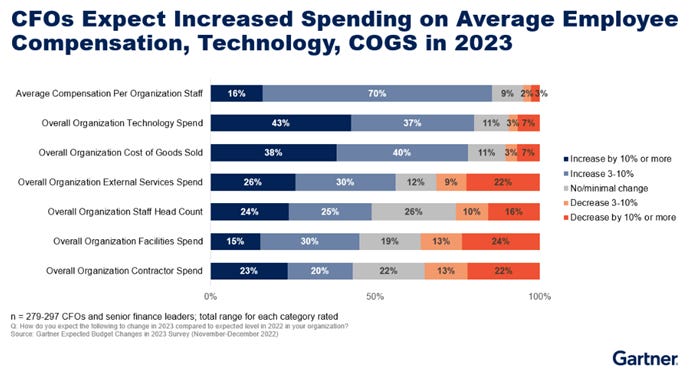
From “Gartner Survey Shows 86% of CFOs Plan to Increase Employee Compensation in 2023, Despite Recession Fears,” a press release:
More:
Investing in digital technology remained a clear top priority, with 80% of respondents planning to increase their technology spend by at least 3%, and 43% planning to increase technology spend by 10% or more. Beyond technology, 78% of CFOs anticipate a higher level of spend for the cost of goods sold.
And, here is one of those things that companies just can’t ever figure out:
The majority of workers that switched jobs from April 2021 to March 2022 — 60% — experienced salary hikes, according to a Pew Research Center survey. Fewer than half of workers who remained with their employer during the same period saw salary increases. [Added in from that Pew study:, in contrast] Among workers who remained with the same employer, fewer than half (47%) experienced an increase in real earnings.
The best way for an individual to advance their career and comp. is to get a new job. Thus, every time I hear companies complaining that they can’t find (or retain) workers, my take is always “have you tried paying more?”
I mean, it’s not like I do the leg work to go through the hassle of looking through want ads, getting and doing an interview, getting an letter in writing, and sending it to HR for counter-bid. But it feels like if the best retention strategy a company has is employees wanting to avoid that hassle that you’ll lose your go-getters and retain the people who enjoy the status quo.

Pew comment on the chart above: “From April 2021 to March 2022, half of the workers who changed jobs experienced a real increase of 9.7% or more over their pay a year earlier. Meanwhile, the median worker who remained in the same job experienced a loss of 1.7%.”
Just imagine how astonished and loyal employees would be if you gave them a 20% raise, unasked for, out of the blue. Even 10%!
Also, I would like a pony.
Wastebook
-
There should be phrase for “sovereign cloud” that means “moving your computing to a jurisdiction that won’t enforce the laws you’re trying to break.”
-
“We allow dogs and beer.” Beckman’s Bookshop.
-
“I understand the music, I understand the movies, I even see how comic books can tell us things. But there are full professors in this place who read nothing but cereal boxes.” White Noise by Don DeLillo.

Relevant to your interests
-
Always have three things – It’s in the game // “Get something to do, someone to love, something to enjoy, and you will become happy. Utility is not the one-and-only moral decider”
-
Setting engineering org values. – “Follow existing patterns unless there’s an order of magnitude improvement.” // Long piece on corporate values, principles. It’s targeted at tech startups so you can see the (for normie companies) astonishing idea that you corporate values describe software and product creation. Nonetheless it’s handy. Also, for marketing at vendors, there’s some good framing on buy vs. building
-
schooled – ‘Educated in a different school. And the key point here — Shippey hints at this, but is not quite as explicit as he might have been — is that Tolkien never expects his readers to know any of what he knows. To fully appreciate Ulysses you need to know the Odyssey, but the reader of The Hobbit need not be aware of Snorri Sturluson’s “Tally of the Dwarves” in his Skaldskaparmál’
-
No Longer the Need for Speed; Revising Our Vision of Customer Journeys – Many B2B customers prefer so self-service purchasing, not talking to a human (I mean, isn’t this true of all types of buyers and citizens interacting with governments?): “75% of buyers prefer a rep-free experience and 68% made a recent significant purchase without traditional rep assistance.” So, they lost three customer journey paths: seamless, prescriptive, learning. They say the learning path leads to more buying.
-
Talking AI – CEO Arvind Krishna on IBM’s monetization strategy – Enterprise AI examples from IBM’s CEO, based on actual customer uses: “if you can automate the drive-through and order taking for quick-serve restaurants, that’s an example of what can happen. If we can get deflection rates of 40%, 50%, 60% at everyone’s call centers, that’s a massive operational efficiency for all of our clients. If we can help retirees get their pensions through interacting with a Watson-powered AI chatbot that is an enterprise use case where all of these technologies come into play. “
-
100 million developers and counting – “there are now officially more than 100 million developers using GitHub to build, maintain, and contribute to software projects”
-
Kubernetes in the wild report 2023 – Some good stuff in here. Among others, Java apps are the dominate type of application, at 65% versus second place, Go, at 15%, followed by Node.js at 9%. “Java, Go, and Node.js are the top Kubernetes programming languages” // with Java having far and above the most apps running in kubernetes.
Logoff
Answering questions is great fun, and also easier than coming up with my own things to write about. Have any questions? Add a comment, or just send it to newsletter@cote.io if you don’t want to share.
I need to get updating/rewriting my platform talk for cfmgmtcamp next week. This should be a super fun task for me, but getting started versus all the other tiny things can be hard. Also, I’ll now be in London for a bit next week. London is, by far, my favorite place to travel for work. The trip is quick, everyone speaks English, and the city is fun to explore. I mean, I love going back home to Austin, but that’s kind of a brutal trip.
Finally, several of you have sent me an email (or otherwise) telling me you enjoy the newsletter. It’s great to hear that, and I appreciate it.
Leave a Reply