Tag: sales
-
”We want adult tension. The tension of brains. If anyone sees sex, that’s on them. We’re not responsible for the public’s imagination. We’re responsible for moving units in Woolworths.”
-
Office hours, DaShaun’s secret to juicing up your enterprise devrel
DaShaun became a great devrel by developing a new way to work with our community. I’ve seen it pay off in all ways, big time. Here is his key differentiation for devrel. The business if devrel: There’s more to developer advocacy than just conferences and content. The real thing that companies [that hire devrel] want,…
-
How to market open core products
Instead of: “Why the ‘free’ version of [INSERT OPEN CORE PRODUCT NAME] could be your most expensive mistake.” A variant: “[INSERT OPEN SOURCE PROJECT] is complex and difficult to secure.” Try: “why these pay-for features will make you awesome and solve shitty problems you toil away at every day.”
-
A Conversation Algorithm I Cribbed From Clinical Psychologists – What does “open ended question” even mean? Here’s some examples, and a conversational framework built around it. This also probably good for sales and marketing.
-
OpenAI reaches 400M weekly active users, doubles enterprise customer base – SiliconANGLE – “The ChatGPT developer currently has 2 million paying enterprise users, twice as many as in September.” With “400 million active weekly users, a 33% increase from December.” And: “The New York Times reported in September that the company was expecting to end…
-

Tactics for having a good executive dinner
I’ve hosted a lot of executive dinners for work – maybe 50 or 60 over the past several years…? These are commercial oriented. At my work, we’re trying to meet new people to sell our software to, or people who know people, etc. Getting to know “executives” is directly related to the sales process. The…
-

Microwaving Fish & Rice Cookers
Just links and waste book today. Wastebook “If it ain’t broke, don’t cloud it,” me, 2011. Follow and mute. “Dell’s employees, whom I believe are mostly adults and not small children, will be given colour-coded ratings to shame those who don’t come into the office enough.” Justin Warren’s newsletter, “The Crux #93.” “Largest companies most…
-

Tech companies should do regional events more
Small, regional events are probably better than the mega-conference I’m starting to think that small, regional events are much – like much – more important for enterprise software sales than the big, annual events. In enterprise sales (where you’re looking to work for a few years to build up multi-million dollar deals), you’re usually targeting…
-
The secret of selling your product to enterprises – Sales is hard and expensive because of all the time and activities it takes, only the multi-quarter timeline, etc.
-
Adding A Product-Led Growth Strategy To A Traditional B2B Organization – Among other things: don’t forget they your sales model is going to drive your product management, eventually.
-
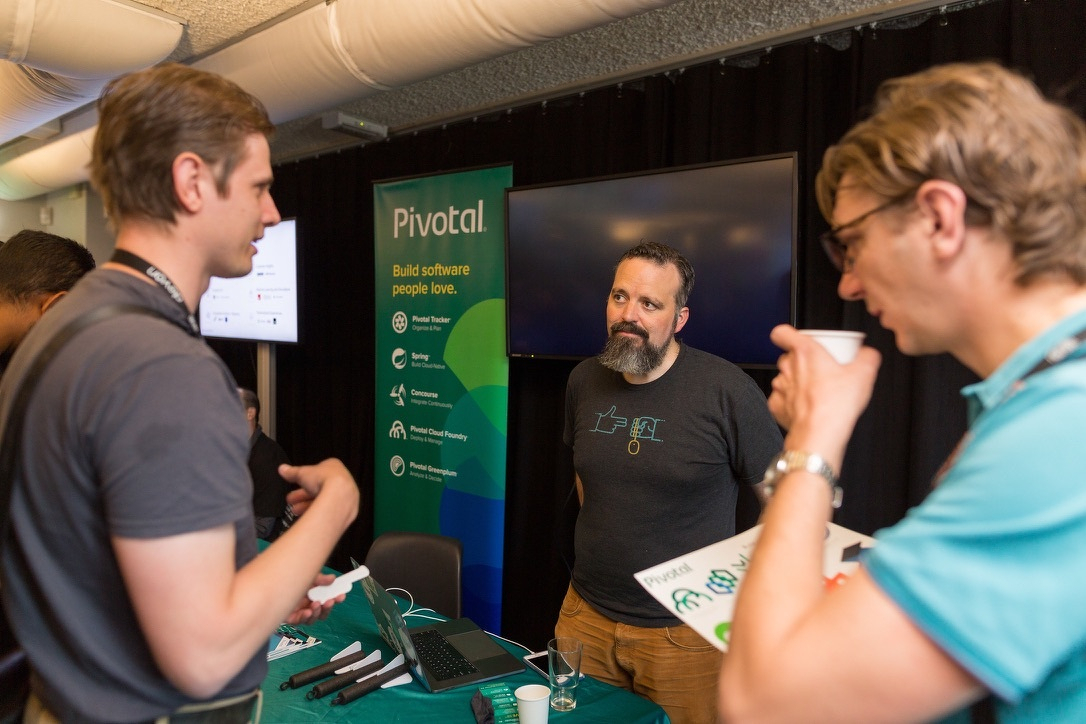
How to do a vendor pitch at a tech conference, working the booth, at HallwayCon, etc.
If you work at a company, or in an open source projects, you’ll have a lot of chances at a tech conference to sell your organization’s stuff: products, cloud services, consulting, promoting your project, or just yourself. You’ll get a lot of opportunities to do this, especially if you’re a sponsor of the event and…
-

Maximizing ROI: The Key to Successful Enterprise Software Company Acquisitions
In Enterprise Software, the Synergy is Sales In my experience, when a tech larger company acquires a smaller one, the most important synergy is sales. “Synergy” in my use just means “the things that make the two companies more money because they are now one.” In enterprise software (or cloud, or whatever), this means changing…
-

Coté’s Commonplace Book – Issue #68
Most software/cloud vendors have people who do competitive intelligence. Here’s what and who that work is useful for. Uses for Competitive Intelligence Jordi asked about the usefulness of competitive intelligence (at software/cloud vendors) in the Software Defined Slack. Here’s what I added to the thread: I think competitive intelligence is least useful for product management.…
-
🗂 Link: High on low-code
Part of the reason for the rise is that buyers are reaching for larger targets. Kony projects its topline will grow to $120m in 2020. Quickbase, Nintex and Mendix were all nearing or above $100m in their recent sales. Source: High on low-code
-
Link: A new player in a new game
Like most other ‘new generation’ IT providers, Fastly plays up its growth rate while playing down the cost of that growth. Sales at the company rose about 40%, year over year, in 2018 to $145m. In comparison, Akamai is a single-digit percentage grower, although it is roughly 10 times larger than Fastly. Fastly also runs…
-
Speed, Accuracy, and Flexibility, IBM circa 1920
The purpose of a sales force is to bring a company’s value proposition—its “deal”—to customers. That value proposition results in the development of a company’s “go-to-market” strategy, how it will implement that plan. Central to that activity can be a direct sales force, people who meet face-to-face with customers, a typical approach with complex and…
-
Management, as practiced by a young IBM
Of course, there were countercurrents. Managers wanted to control activities. That impetus for control and management of potential risks led to the rise of bureaucracy, characterized by highly defined processes. Generations of executives micromanaged people all the way down the organization while fighting the growth of paperwork and “signoffs.” Such behavior also originated with Watson…
-
Link: Are security concerns over Huawei a boon for its European rivals?
Between 2015 and 2018 Huawei’s share rose from 24% to 28%; Nokia’s dipped from 20% to 17% and Ericsson’s from 15% to 13%. An escalation in the war on Huawei might prompt Beijing to retaliate by kicking Western firms out of China. That would be a blow to the Nordic duo. China accounted for…
-
🗂 Execs think more optimistically about app dev practices than reality
> The same HBR survey found that 61 percent expect software release cycles to be three months or less, but only 27 percent of their companies actually achieve that goal. The takeaway is that executives aren’t hands-on enough to know how much time software development takes. Without a deeper understanding, they are prime targets for…
You must be logged in to post a comment.