Tag: microblogimport20260616
-
Defeating Conway’s Law
Try using a platform to combat Conway’s Law and organizational friction caused by too many groups/silos. This matters because it removes the structural excuse for fragmentation. When a single platform surfaces all the controls a unified team needs, there is no longer a technical reason to keep five separate teams in five separate rooms. The…
-
you can’t measure productivity
The [Wells Fargo] CEO named auditing, testing, legal, contracts, patent filings, pitchbooks in investment banking and credit memos as a handful of areas across the company executives see room for AI to improve processes. “How much of that actually results in pure margin or return expansion is to be seen.” Scharf said, since competitors will…
-
security over features
From what I can tell, every core part of the software stack is stopping what they’re doing and taking care of the flood of new, AI-driven security issues. 🔗 Java Maintenance Engineering Shifts Focus on Quarterly Critical Patch Stabilization
-
🤖 “descended into madness” – Backrooms
Original: A Backstory from My Backrooms by Paige K. Bradley. Summarized by AI on June 3, 2026. {I love backrooms. One of the first things I did with AI image generator was make endless empty malls and backrooms. So good. -Coté} A stray 2019 4chan post about a bland, fluorescent-lit interior sparked the viral myth…
-
🤖 Valiantys-Glean Partnership Bets That Cross-Platform Knowledge Graphs and Behavioral KPIs Are What Move Enterprise AI Past Pilots
Original: Enterprise AI is still stuck at experimentation – Valiantys and Glean think they know why by diginomica. Summarized by AI on June 3, 2026. Most enterprise AI pilots stall, and the diagnosis from Nathan Chantrenne, Chief AI Officer at Valiantys, is that the field measures the wrong things and fragments its tooling. The dominant…
-
🤖 AI Collapses Build Costs but Expands Alignment Burdens for Senior Engineers
Original: Is this sustainable? by Jamie Hurst. Summarized by AI on June 3, 2026. AI has collapsed the distance between idea and implementation. Senior engineers can now move from concept to working proof-of-concept in days, bypassing the old cycle of proposals, approvals, and sequential team work. This shift has replaced slide decks with demos, rewarding…
-
Enterprise self-harm: cleaning the data is the hard part
I think the critical part of it was really realizing that we had built the original product presupposing that our customers had data integrated, that we could focus on the analytics that came subsequent to having your data integrated. I feel like that founding trauma was realizing that actually everyone claims that their data is…
-
🤖 How People Are Really Using AI in 2026: Thinkslop, Therapy, and Shadow Work
Original: How People Are Really Using AI in 2026 by Harvard Business Review. Summarized by AI on June 2, 2026. Generative AI has become deeply embedded in daily life, with 900 million regular ChatGPT users and Google Gemini close behind. A longitudinal study of 12,637 fresh use cases shows adoption expanding across personal, emotional, and…
-
Why aren’t all images super-secure, or hardned?
Here’s what I learned: container base images grew up as a developer convenience tool, not a security artifact. Installing extra packages from the command line is one of the first things any Docker tutorial teaches–Docker’s own Dockerfile guide includes apt-get install–and many of the most popular official images ship a full toolchain by default, with…
-
Three reasons why a “batteries included” platform is urgently needed right now
Removing product as a bottleneck: The conversation around PaaS is urgent again, and AI is why. Code generation can speed up your development cycles, building and pushing features faster, but production delays will persist if you’re still deploying at the same speed as before. To avoid eroding the benefits of code generation, you need to deploy…
-
🤖 AI Productivity Gains Stall at Firm Level: The Three Stages of ROI
Original: Why AI isn’t showing up on your bottom line by Azeem Azhar. Summarized by AI on June 1, 2026. AI tools have made individual workers faster and more productive, with engineers producing more code and teams feeling tangible time savings. Yet firms see little proportional ROI, echoing Robert Solow’s paradox of computers appearing everywhere…
-
Enterprise AI ROI strategy: do both individual productivity and new revenue sources
“The most important question for CFOs is not how much can the organization spend on AI, but whether those investments are being deployed in ways that reinforce the business’s core growth and value drivers,” said Carlsen. “Moreover, the near-identical amount of use cases for efficiency and productivity use cases between efficient growth firms and control…
-

Sucking Air Through Their Teeth, 50/50 success/failure, and Dell’s $43B AI Server Quarter – Related to your interests, Friday
Also: the improbable life, four years working at AWS, an AI-SDLC panel debate. Spotted by Dan Bettinger in Austin. Related to your interests Most generative AI and custom model projects will be a bust: Gartner – ‘Analyst firm Gartner thinks at least half of all generative AI projects “will overrun their budgeted costs due to…
-
50%+ failure is normal
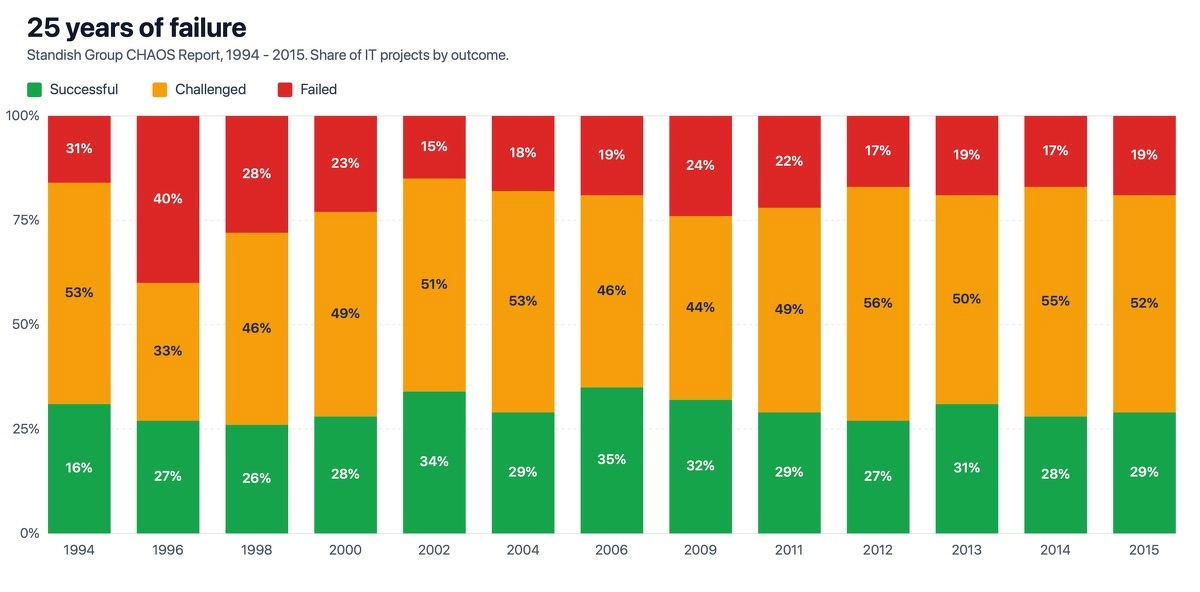
Analyst firm Gartner thinks at least half of all generative AI projects “will overrun their budgeted costs due to poor architectural choices and lack of operational know-how,” and most organizations that try to build custom models “will abandon their efforts due to costs, complexity and technical debt in their deployments.” Yes, and this matches decades…
-
If speeding up coding was never the problem…then why are we spending money on speeding it up?
When it comes to measuring developer productivity driven by AI, we’ll probably land on the same conclusion as always: counting lines of code isn’t as useful as measuring the full cycle time from idea to code to delivery to a person actually using the app – lead time, concept to cash, whatever you want to…
-

Good O-Rings and Bad O-Rings, the AI Efficiency Plateau, and Anti-Labor by Design – Related to your interests, Thursday
Also: Goldman’s 24x token forecast, Indian IT’s process-debt pitch, NatWest’s 35% AI-generated code, Gartner’s 84% productivity theater, vibesec. From: “AI Agents Forecast to Boost Tech Cash Flow as Usage Soars,” Goldman, May, 2026 Related to your interests ‘I’m delighted to be wrong’: Sam Altman says AI won’t lead to a ‘jobs apocalypse’ – but admits…
-
Elusive Enterprise AI ROI: No scaling, it’s not legible, lack of skills/need for training
Despite everything, reports are still that enterprise AI ROI is elusive. At the same time, for enterprise buyers, the bill is finally coming due for the past year of AI amazement. It’s not cheap. What’s up with this elusive enterprise AI? Gartner has some survey-driven theories for finance departments. One theory is that there actually…


You must be logged in to post a comment.