
Here are some kubernetes things I probably mentioned:
- The State of Kubernetes 2023 Survey. Here’s a talk where I go over my analysis of it.
- Also, my three-part analysis of it: multi-cloud, tools, benefits.
- Check out VMware’s Kubernetes stack, VMware Tanzu Kubernetes for Operations.
- You can take it for a test run in our Pathfinder Lab.
- If you’re managing multiple Kubernetes clusters, across the major services and distros, you should check out VMware Tanzu Mission Control. It’s a Kubernetes manager that’s a SaaS or that can run on-premises.
- Kubernetes’ value comes from what you build on-top of it. If you want to run applications, you’ll need to build a platform on-top of it. That’s exactly what the VMware Tanzu Application Platform is. It also includes all sorts of developer frameworks and tools from CI/CD, API management, and an internal developer portal.
- Here’s my research on building and running developer platforms, aka “platform engineering” and Platform as a Service.
My primary concern and critique of Kubernetes right now is that it doesn’t seem to be making software development and delivery better. In fact, as it is used by more and more people, it’s making things worse:
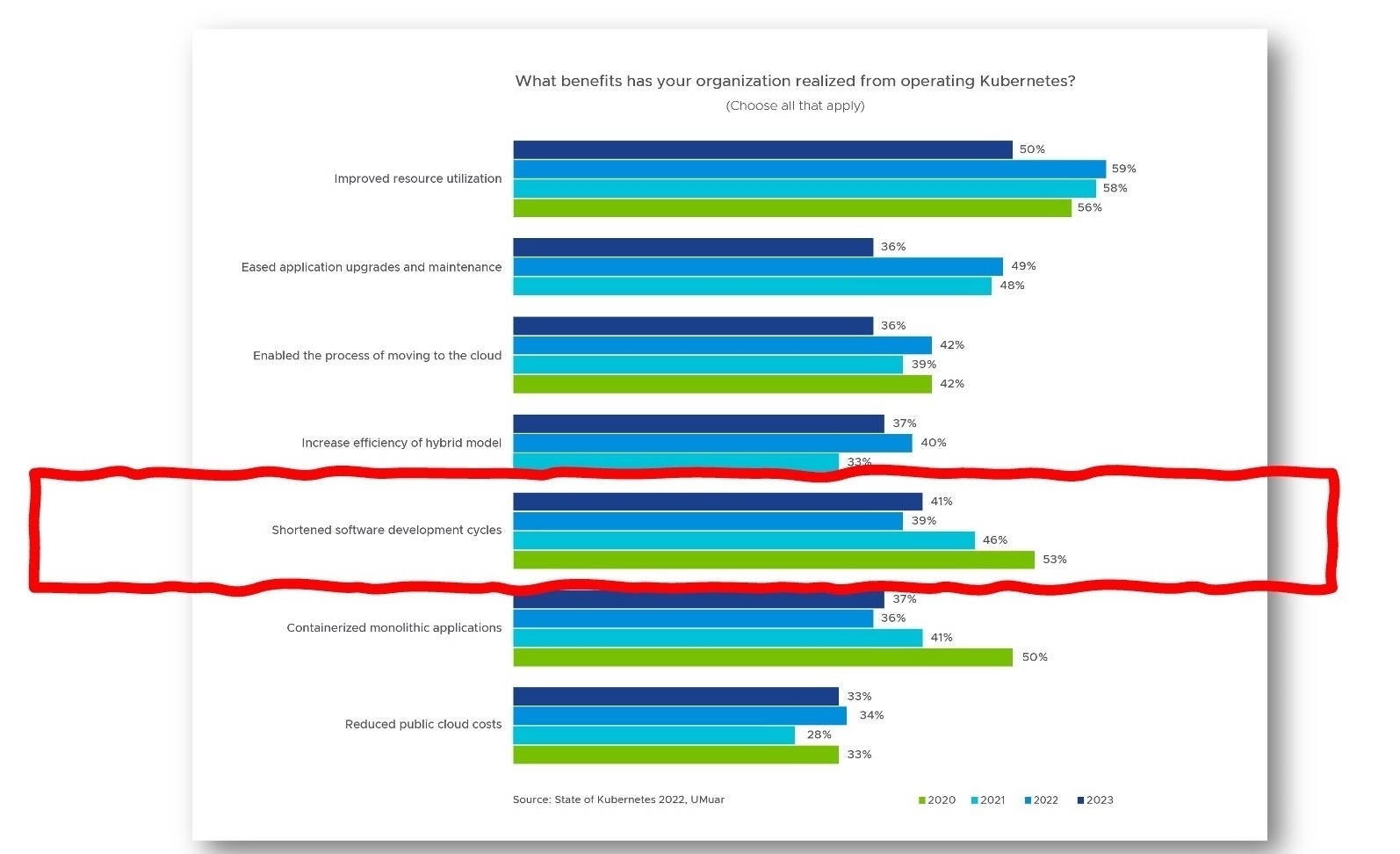
This will probably be fixed over time, but people blindly putting Kubernetes in place because “it’s the future” need to do so with care and deliberate planning. Thankfully, there’s well over seven years of people learning how to do this with the app platforms that came before Kubernetes like Cloud Foundry. And many of them are still doing it, for thousands of applications in production at real companies.
Also, the “container wars,” which Kubernetes “won,” have been a huge distraction from focusing on application developers. This is evidenced by the rise in developer experience and platform engineering that is, to me, reinventing , from scratch a lot of what we already had but threw out in favor of “the future.” So it goes.
Kubernetes has many benefits, but don’t assume it’ll be easy.