
I’ve been having a terrible time getting talks accepted at conferences. Talking at conferences has, you know, been a huge part of my life for about 20 years, so this is kind of a bummer. Care to join me in some self-pity-partyingcare?
I’ve got the wrong haircut
What gives with my high rejection rate? My theories are:
- I don’t have enough new material. Who wants to hear my stories about platform engineering, stealth complaining about Kubernetes ruining the progress we made in PaaS, private cloud, or playing D&D with AIs?
- People don’t like abstracts written in that ironic Gen-X way like they did in the 2010’s. Maybe the conference pickers have gotten more genuine and optimistic as us olds move on.1 I can’t help but write ironically, though, a joke only to myself in every title and third sentence – my fingers are wired to it. Perhaps I need to be less Letterman, more Ted Lasso.
- It seems my abstracts are 100% AI written. If #2 is true, it might actually be a good idea for me to ask the AI to convert my abstracts into whatever tone the CFP-pickers vibe on nowadays.
- It could just be that people look at me and say “no thank you.” I can see that I throw off strong “hidden vendor pitch” vibes.
Who knows.
The eternal reoccurrence of everything
I find it hard to come up with new topics.
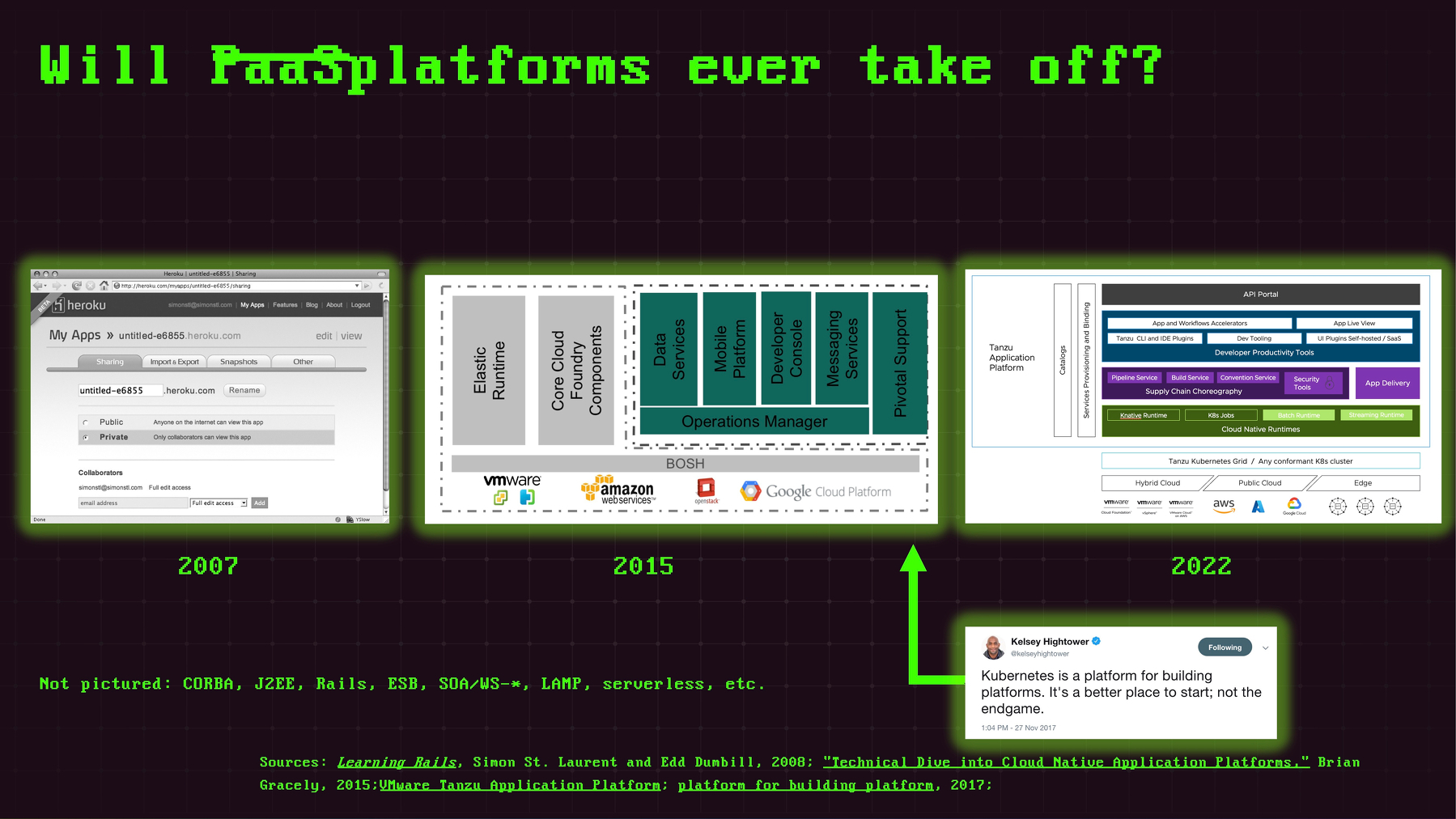
I presented on platform engineering, as it’s called now, for about a decade. There isn’t much left to say except don’t build it yourself and product manage it. Stay off the tinker path to ROI failure.2
You can present on AI, but by the time you give the talk six months after submitting it, everything will have changed dramatically. Think back six months ago, November, 2025. That was right as the Claude Code is God/Harness wave we’re currently in started. OpenClaw was Christmas of 2025. MCP was at its height of popularity back then, so you would have written a CFP about that. There’s probably tons of MCP talks going on this Spring and, like, that’s kind of a solved problem and concept now.
Seriously: at this point, if you’re running a conference with AI talks, you should just be accepting abstracts that say “I’ll demo and talk about whatever is cool in AI in six to ten months.”
Plus, on AI, what is there left to present on? It just works amazingly well. Now, we just need to wrap all that enterprise-y stuff around AI, and we’re good to go.
Oh, and I should clarify: despite my generational mind-warping, I’m not being ironic here.
meatsack.pptx
This leaves “people” stuff and career advice. However, that doesn’t really fit into my professional remit. (Ahem…see the hidden vendor pitch problem above.)
The most recent talk I got accepted was an updated version of my surviving and thriving in BigCo’s talk, which I’m thrilled to be doing! I only submitted it, though, because it’s an easy train ride to Utrecht. That kind of talk isn’t justifiable as a business expensed one.
So, what’s left is for me to try to shift out of meat-ware (platform engineering theory, process, and “strategy and management”) back into software.

This whole talk was written by AI
Thanks to Claude Code, this is actually possible. For example, I have a lot to say about using Cloud Foundry as the bash/shell tool, over SSH. You get all the enterprise-y stuff!
What’s, well, “fun” about this kind of AI assistance is that it makes you focus on the craft of presenting and demoing. The technology is easy and possible…and sort of irrelevant. How did Claude Code implement this running a shell thing in Cloud Foundry? I mean, it did a good job…but who cares? It works, and you can change it around at will.
How you present this and connect it to “real world” problems and fixes, hopes and dreams, is the more interesting part. And that’s what’s fun about crafting and giving a presentation: the creation of an event, a happening, an experience both for the audience and the presenter.
We’ll see.

- Have you noticed that the kids these days all have curly mullets and mustaches? I live in a sleepy Amsterdam suburb, and I see at least one John Oats a day. Go into the city, and it’s like there’s some kind of Hall and Oats tribute band festival going on. Back in my day(!), why, sure, you could mullets galore, but everyone knew you were doing a bit. But, I guess, you know, when it comes to aesthetics, sure: I make no moral judgements. Wear your hair like you dig, Oats-ites. ↩
- Despite my sentiment, this seems like the prime time for platform engineering talks. Abby, for example, gives great ones. There’s a whole platform engineering track at KubeCon! Perhaps this is more a “me” problem: there seems to be plenty of hunger for platform engineering talks, which scratches the head more here. ↩
Leave a Reply