On average, ChatGPT Enterprise users attribute 40–60 minutes of time saved per active day to their use of AI, with data science, engineering, and communications workers saving more than average (60–80 minutes per day).
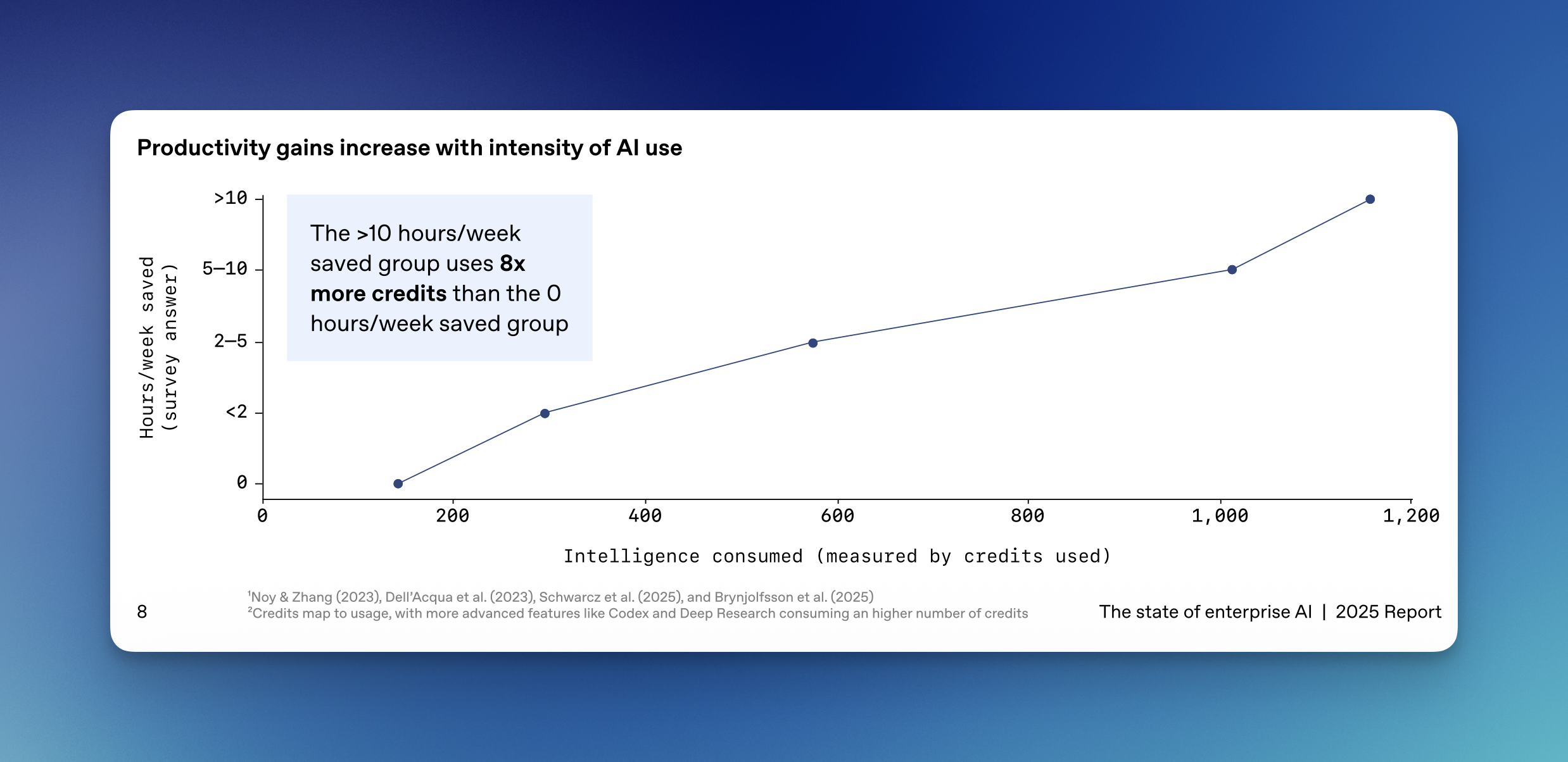
That’s the headline grabbing piece from the recent ChatGPT for work study. The theory take-away from that is that the more you use ChatGPT, the more productive you are.
Also, the current use revolves around chat and coding. The use cases are chat applications with many of them being better search over inventory, how to for projects Lowes for that), and then searching over complex regulations and legal text. That is: sloppy search and text based content. This is fine! It gives you some strategic targeting: if you want to do an AI project, find text-heavy tasks to improve.
Doing more analysis is an area for growth. Even “Frontier firms (95th percentile)”1 have about 20% headroom to work with there.
Of monthly active users, 19% have never used data analysis, 14% have never used reasoning, and 12% have never used search. Among daily active users, those shares drop to 3%, 1%, and 1%, respectively.
Also, as someone who likes to just capitalize the first letter of titles, dig them doing the same for the report title. I don’t know why I like this style. I suspect it’s because I like to give a winking “I know I’m messing with MLA-whatever” to people who notice.
Highlights
Here’s ChatGPT 5.1’s analysis of the report, and here are my highlights:
Page 4
OpenAI’s more than 1 million business customers
provides a distinctive view into this shift
Page 5
Since November 2024, weekly Enterprise messages have grown approximately
8x in aggregate, with the average worker sending 30% more messages.approximately 20% of all Enterprise
messages were processed via a Custom GPT or ProjectBBVA regularly uses more than 4,000 GPTs, indicating
that AI-driven workflows are increasingly implemented as persistent tools
embedded in daily operations
Page 6
Average reasoning token consumption per organization has increased by
approximately 320x in the past 12 months, suggesting that more intelligent
models are being systematically integrated into expanding products and
services.
Page 7
Seventy-five percent of surveyed workers report that using AI at work has improved
either the speed or quality of their output. On average, ChatGPT Enterprise users
attribute 40–60 minutes of time saved per active day to their use of AI, with data
science, engineering, and communications workers saving more than average (60–80
minutes per day). Time saved per message varies by function: accounting and finance
users report the largest benefits followed by analytics, communicationsand engineering.87% of IT workers report faster IT issue resolution
85% of marketing and product users report faster campaign execution
75% of HR professionals report improved employee engagement
73% of engineers report faster code delivery
Page 10
In absolute terms, ChatGPT Enterprise customers are most
concentrated today in professional services, finance, and
technology, sectors that were early adopters and continue to
lead in their scale of AI usage. Healthcare and manufacturing
started from a much smaller base but are now among the
fastest-growing sectors, rapidly closing the gap
Page 13
To understand this growing divide more deeply, it is useful to compare frontier
workers (defined as those in the 95th percentile of adoption intensity) to the median
worker. Frontier workers generate 6x more messages than the median worker. Even
among those who work in data analytics, frontier workers use the data-analysis tool
16x more than the median.
Page 16
A 2025 Boston Consulting Group (BCG) study found
that over the past three years, AI leaders achieved 1.7x
revenue growth, 3.6x greater total shareholder returnand 1.6x EBIT margin. They also outperformed on non-
financial measures such as patent output and employee
satisfaction, linking AI maturity to both financial and
organizational strength. While this evidence is still earlyit suggests that AI adoption is correlated with improved
financial performance and organizational outcomes
Page 18
Mylow is available on Lowes.com and in the award-winning Lowe’s mobile app.
When customers engage with Mylow during their online visits, t he conversion
rate more t han doublesMylow Companion is deployed in 100% of stores and answers hundreds of
thousands of associate questions each week. Lowe’s is seeing customesatisfac tion scores increase 200 basis points when associates use Mylow
Companion to help customers shopping in the aisle.
Page 20
In Mexico, BBVA must perform a legal check
(also known as bastanteo) to confirm that a
company representative has the authority to sign
and act on behalf of the company before key
transactions can proceed (e.g., opening
accounts, signing contracts, issuing credit).
Historically, this process relied on a specialist
legal team responding to repetitive branch
queries, creating delays, bottlenecks, and high
demand for scarce legal capacityBBVA built a generative AI chatbot that provides
instant access to standardized, pre-validated
legal FAQs and documentation guidance for
common signatory-authority questions. The
content was developed and reviewed by BBVA’s
Legal Services team, reducing manual handling
of daily inquiries and making approved legal
guidance consistently available.automates more t han 9,000
queries annually and has enabled BBVA to redeploy the equivalent of 3 FTE’s
toward producing over 11,000 bastanteos per year, delivering 26% of t he Legal
Services division’s annual savings KPI.
Page 21
Oscar developed a pair of member-facing
chatbots to answer member benefits, costs and
general health questions, on-demand and in realtime. Unlike general-purpose AI chatbots, these
are integrated with Oscar systems and dataallowing them to draw from medical recordsclaims, and customer service interactions to
personalize responses. Their chatbots can also
assist with common tasks, including finding in-
network doctors and refilling prescriptionsTheir platform answers 58% of
benefits questions instant ly and is able to handle 39% of benefits messages
wit hout any human escalation. Today, they now have t he foundation for future
capabilities, including appointment booking, voice interactions, and condition-
specific management
Page 22
teams can spend more time pressure-testing trade-offs
and making higher-quality decisions earlier in the TPP creation processModerna reports that a core analytical step in this process has been reduced
from weeks to hours in some cases, and believes that each day gained in early
TPP planning can help t he company deliver for patients more quickly.
-
I don’t know, using “frontier” to describe people instead of models seems dangerous. That work will star to lose meaning if its applied to more things. ↩
Leave a Reply